
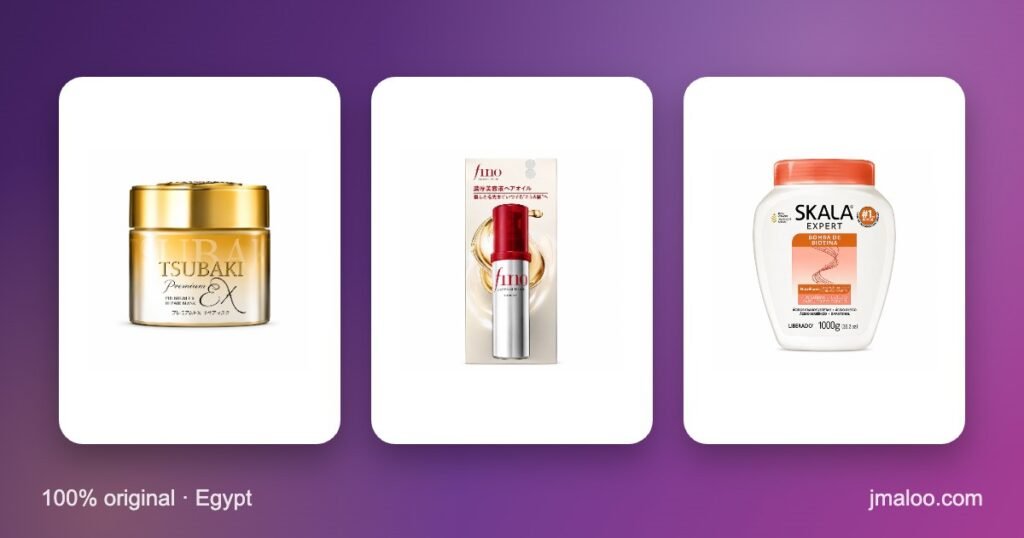
If your hair feels rough by mid-afternoon, snaps when you comb it and looks frizzy no matter how much serum you use, you are not imagining it: Egypt is a difficult place for hair. Between hard tap water, dry heat, daily straightening and the keratin and protein treatments so many of us have had done, dryness and split ends are almost the default. The good news is that a proper dry damaged hair routine does not need to be complicated or expensive. In this guide we walk through the causes that are specific to Egypt, a simple weekly routine, a budget version and a premium version using products we stock at Jmaloo, a four-week schedule you can follow from this weekend, and an honest answer to the question everyone asks about split ends.
One note before we start: we already have a separate post on protecting hair from sun, sea water and summer heat in Egypt. This article is about repair, not sun protection, so if your problem started at the beach, read both.
Why dry damaged hair is so common in Egypt
Understanding the cause matters, because a routine that ignores it will only mask the problem for a day or two. In our experience with customers across Cairo, Giza and Alexandria, five things come up again and again.
- Hard water. Tap water in most Egyptian cities carries a lot of calcium and magnesium. These minerals sit on the hair shaft, making it feel coated, dull and stiff, and they stop conditioner from absorbing properly, so you use more and get less.
- Dry heat. Low humidity for most of the year pulls moisture out of the hair, especially in Upper Egypt and on windy days in Cairo. Air conditioning indoors does the same thing.
- Daily heat styling. A flat iron or blow-dryer used every morning at high temperature slowly cooks the cuticle, and dry hair loses its ability to hold moisture at all.
- Keratin and protein treatments. Salon protein treatments are extremely popular in Egypt, and repeating them every few months, often combined with bleaching, leaves the hair over-processed, brittle and prone to breakage rather than softer.
- Dye and highlights. Colour opens the cuticle to deposit pigment, and the lightening step in particular removes the natural lipids that keep hair flexible.
Most readers will recognise at least two of these. That is fine: the routine below addresses all of them, and you simply weight it towards your biggest cause.
The hair care routine for dry hair in Egypt: five steps in order
A good dry damaged hair routine has a fixed order, and the order matters more than the brand. Think of it as cleanse gently, replace what you removed, deep-treat once a week, seal, and protect.
Step 1: a gentle shampoo, and less often than you think
Wash two or three times a week, not daily. Use a shampoo formulated for dry or damaged hair, lather only the scalp, and let the foam run down the lengths as you rinse rather than scrubbing the ends. If your water is very hard, finish with a final rinse of cooler water; it helps the cuticle lie flat and reduces mineral build-up.
Step 2: conditioner every single wash
Apply conditioner from the ears down, comb it through with a wide-tooth comb while the hair is still coated, and leave it for at least two minutes before rinsing. Skipping conditioner “to keep hair light” is one of the most common mistakes we hear about, and it is the fastest route to frizz.
Step 3: a weekly deep mask
Once a week, replace conditioner with a mask and leave it on for ten to twenty minutes under a shower cap or warm towel. This is the step that actually changes how your hair feels over a month, so do not skip it when you are busy.
Step 4: leave-in or oil on damp hair
On damp hair, apply a leave-in cream or a few drops of hair oil to the mid-lengths and ends only. This seals moisture inside before the dry air pulls it out and is the single best frizzy hair treatment for Egyptian weather. Keep oil away from the scalp unless your scalp is dry too.
Step 5: heat protection habits
Let hair air-dry at least halfway before using a dryer, keep straighteners below 180°C, and give yourself two heat-free days a week. Sleep on a satin or silk pillowcase or in a loose satin bonnet, and never brush hair while it is soaking wet.
Start with the mask. If you change only one thing this month, make it a weekly deep-conditioning mask. The Skala Shea Butter mask is a full 1kg tub for 299 EGP at the time of writing.
Best products for damaged hair in Egypt: a budget routine
You do not need to spend thousands to see a difference. This whole routine costs under 1,300 EGP at the time of writing and the tubs last for months because they are 1kg each.
- Weekly mask: Skala Expert Shea Butter Hair Mask 1000g (299 EGP). Rich, vegan and heavy enough for very dry or thick hair. If your hair is fine, the Avocado & Castor Oil mask at the same price is a little lighter.
- Leave-in cream: Skala Fruitastic Banana & Bacuri 2-in-1 Treatment Cream & Leave-in 1000g (599 EGP). It works as a conditioner in the shower and as a leave-in on damp hair, and it is made specifically for dry, frizzy hair.
- Oil: Difeel Argan Hair Oil Blend 210ml (399 EGP). Two or three drops on the ends after the leave-in, and a drop rubbed over dry hair on non-wash days to tame flyaways.
- Everyday conditioner: if you prefer a separate rinse-out conditioner, the Boots Everyday Coconut & Vanilla Conditioner 500ml is 299 EGP.
The premium routine: Japanese repair from Shiseido and K18
If your hair has been through repeated protein treatments, bleach or years of daily ironing, the premium routine gives faster, more visible results, particularly on shine and elasticity.
- Shampoo and conditioner: TSUBAKI Premium Moist & Repair Shampoo 450ml and the matching Moist & Repair Conditioner 450ml, 1,199 EGP each. The camellia oil formula is one of the most requested Japanese hair products we sell, and customers tell us the softness is noticeable from the first wash.
- Weekly mask: Fino Premium Touch Hair Mask 230g (599 EGP). A salon-style treatment that only needs a few minutes. If you go through it quickly, the 700g refill is 1,399 EGP.
- Oil: Fino Premium Touch Hair Oil 70ml (1,199 EGP), a lightweight finishing oil that also gives some protection before heat styling.
- For chemically damaged hair: K18 Leave-in Molecular Repair Hair Mask (1,999 EGP). Used after shampoo, without conditioner, and left in for four minutes before styling. This is the product we recommend to anyone whose damage came from bleach, keratin or repeated colouring; it is the one that makes a real difference to elasticity, and a small tube goes a long way because you use very little.
You can also mix the two: many customers use the Tsubaki pair with a Skala tub as their mask, which keeps the monthly cost sensible while still upgrading the wash step.
Your four-week dry damaged hair routine schedule
Here is the plan written out so you can screenshot it. “Wash day” means gentle shampoo plus conditioner, then leave-in or oil on damp hair. Wash days are Saturday, Tuesday and Thursday in this example; shift them to suit your week.
| Week | Wash days | Mask day | Heat | Extra |
|---|---|---|---|---|
| Week 1 | Shampoo + conditioner, leave-in on damp hair | Saturday: mask 15 min under a warm towel | Maximum three heat-styling days, below 180°C | Book a trim if ends are visibly split |
| Week 2 | Same, add a cool final rinse | Saturday: mask 20 min | Two heat-free days | K18 on wash day if hair is chemically damaged |
| Week 3 | Same | Saturday: mask; Tuesday: extra 5-minute mask if hair is very dry | Two heat-free days, air-dry halfway first | Oil on dry ends on non-wash days |
| Week 4 | Same | Saturday: mask 20 min | Three heat-free days if you can manage it | Assess: less frizz, easier combing, fewer snapped hairs? |
By the end of week four, most people notice that hair combs through more easily, frizz settles faster after washing and the ends feel less crunchy. That is the point at which to keep the same dry damaged hair routine going rather than change products again.
What not to do when treating split ends at home
- Do not wash daily with a clarifying or anti-dandruff shampoo unless your scalp needs it; it strips the lengths.
- Do not apply masks to the roots. They weigh the hair down and can make the scalp oily while doing nothing for the ends.
- Do not book another protein or keratin treatment because the last one “wore off”. Over-processed hair usually needs moisture, not more protein, and stacking protein makes it stiffer and more likely to snap.
- Do not use a fine-tooth brush on wet hair or towel-dry by rubbing. Squeeze water out with a cotton T-shirt instead.
- Do not trust anyone who promises to repair split ends permanently with a bottle. Read the next section.
How to treat split ends at home, and when you need a trim
Here is the honest answer. Once a hair splits, no product on earth glues it back together permanently. Oils and leave-ins can smooth a split end so it looks sealed for a day, and that is worth doing, but the split is still there and will travel up the shaft if left. The only real fix is cutting above the split. What a good routine does is prevent new splits, so you trim less and keep length longer.
A practical rule: if you can see white dots or forked ends when you twist a section, or if the ends catch on each other when you run fingers through, book a light trim of one to two centimetres, then start the four-week plan. Repeat a small trim every eight to twelve weeks while your hair recovers.
Build your routine today. Everything in this guide is 100% original from official stockists, delivered to any governorate in Egypt with cash on delivery, and delivery is free on orders over 1,999 EGP.
FAQ
How long does a dry damaged hair routine take to show results?
Most people feel a difference in softness after the first weekly mask, and see less frizz and easier combing within three to four weeks of consistent use. Hair that has been bleached or over-processed with protein treatments takes longer, often two to three months, because damaged lengths need to grow out gradually.
Can I use a hair mask instead of conditioner every time I wash?
You can if your hair is very dry and thick, but for most people a mask every wash is too heavy and leaves hair limp. The better pattern is conditioner on every wash and a mask once a week, or twice a week during the driest months. Always keep both away from the scalp.
Which is better for damaged hair in Egypt, Skala or Tsubaki?
Both work well; the difference is budget and texture. Skala 1kg tubs are extremely good value at 299 to 599 EGP and suit thick, curly or very dry hair. Tsubaki at 1,199 EGP per bottle feels lighter and gives more shine, which fine or straight hair usually prefers.
Is K18 worth 1,999 EGP for keratin-treated hair?
In our experience, yes, for hair damaged by bleach, dye or repeated keratin and protein treatments, because it targets elasticity rather than only coating the surface. You use a small amount after shampoo, so one tube lasts many washes. For hair that is simply dry from weather or heat, a good mask is enough.